Showing posts with label the language of thorns. Show all posts

Monday, November 13, 2017

Short Story Sunday - Language of Thorns #6


34076952
When Water Sang Fire

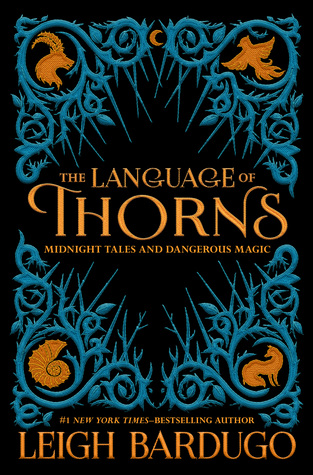
This story is the longest in Bardugo's collection, The Language of Thorns, and therefore provides the deepest character connections and the most intricate, magical detail. "When Water Sang Fire" is the story of a mermaid, Ulla, and her dearest (if only) friend, Signy. As mermaids, or merpeople, these special creatures have the power to sing magic into being. When they are young, Ulla and Signy learn that together they are the strongest singers in their colony. They can sing almost any magic into being.

The trouble with this story comes when Ulla and Signy are chosen by one of the princes, Roffe, to accompany him onto land for three months. During those three months, all of the princes are tasked with trying to win the kingdom by bringing the current king a gift from the mortal world. Roffe knows that his best chance at winning the title is with the help of Ulla and Signy. Though Ulla knows this, Signy's feelings for Roffe cloud her judgment. When Ulla realizes that bringing the current king fire would undoubtedly let Roffe win, she tries to find the right spell for it, but the cost is greater than what she thinks possible. Roffe does not agree and forces her to do it.

This short story seems like it may be Bardugo's prequel to "The Little Mermaid" stories, but in it, we learn about Ursula. This idea is mentioned in the author's note at the end of the book and the sadness and terror of this specific story are more than enough to drive someone good to become someone evil. "When Water Sang Fire" covers themes of love, friendship, ambition, and sacrifice. The main theme of love and friendship is borne between Ulla and Signy but is threatened by Signy's feelings for Roffe. The theme of ambition is shown to be a dangerous one as Roffe is willing to hurt others for his own gain. And the overwhelming feeling of sacrifice echoes hollowly after Ulla gives everything for Roffe and Signy but receives nothing in return. Though this is the longest and most in-depth story of the collection, I don't think it's my favorite, but I do think it'll be the one that haunts me. Its message is powerful and melancholy as it cries out that trust is not always deserved and is often morphed by betrayal.

Other Stories:

Sunday, November 5, 2017

Short Story Sunday - Language of Thorns #5


34076952
The Soldier Prince


Droessen is a clocksmith who creates little wonders for his customers. But he wanted more than to be just a tradesman; he wanted to be rich and have a wife. He sets his eyes on a young girl named Clara, who he believes he can make love him as she grows into a young lady. He gives Clara a nutcracker as a gift and it has a strange hold over her as it can speak to her and take her to amazing and unbelievable places.

Though the Nutcracker lives in her dreams and takes her to magical places, showing her fantastical things, it makes her life seem dreary in comparison. With the help of other toys Droessen has made, the Nutcracker learns of a way that he could become real. He begins to want and though Clara refuses his desires, her brother Frederik helps him.

The siblings name him Josef and as he becomes real, he struggles to keep his focus on his new wish: to go outside. When the desire for something is subdued, he begins to turn back into a toy. This new development upsets Droessen as he was using the Nutcracker to learn about Clara, as a spy. When the Nutcracker meets Droessen, the clocksmith uses words to force him back into his toy state. The Nutcracker battles his own mind to remain real and then battles Droessen. With determination and will, everything the Nutcracker says becomes true and he gets to live.

I think this story is one of the most fantastical in the collection. It speaks to themes of growing up, dreaming, escaping the hold that other people have on you, and getting lost in fantasy. It also includes the idea of forcing someone to love you and how that doesn't work, demonstrated by Clara falling in love with the toys, but not with Droessen. Though none of the characters seemed to really learn anything from this, I guess you could say that they all got what they deserved. Especially Droessen. The evil that he (seemingly) used to create his toys eventually returned in the form of karmic retribution. This wasn't my favorite story so far, but I really enjoyed the magical aspect of it and the intricate descriptions that Bardugo used. The details she includes add a little more spark to all of the aspects of the story.

Next story: When Water Sang Fire

Other Stories:

Review of the entire collection will come after next week's Short Story Sunday. 

Sunday, October 22, 2017

Short Story Sunday - Language of Thorns #4

34076952
Little Knife


This is the story of how a once bustling town decayed into a decrepit haunt that everyone tries to avoid, as its curse could crawl away with any visitor.

Yeva, the main character, is a girl who only grows more beautiful with age. She is so beautiful that even friends would try to kidnap her. And though this may seem wonderful, for Yeva it is not. Eventually, she is too beautiful to leave her home without someone trying to take her or chaos breaking out in response to not having her. Her beauty works as a sort of spell to twist the will of anyone who sees her.

When she comes of age, Yeva's father creates a contest to win her hand in marriage.

Semyon is a Tidemaker, a member of the Grisha, and though he is very poor he decides he wants to marry Yeva. His powers to control water help him complete the initial task, but Yeva's father sets another because he doesn't want his daughter marrying anyone but a prince.

Throughout this 'contest' Yeva is focused on only one thing: how do these tests determine if the man will be a good husband? (Good question, sister!) I think it's this question that aligns the readers with Yeva. Through her repeated asking, readers realize that she doesn't really care about gold, or fancy food, or imported fabric. She's deeper than that. 

Semyon completes the second task but then comes a third and final trial. Again, Semyon achieves the task's goal but wonders if Yeva's father will just try to continue setting tasks or kill him after he hands over the prize. Semyon thinks he comes up with a plan to avoid this, but he underestimates the power of Little Knife, the river who helped him complete all of the tasks. It turns out he cannot control the water; the water had been using him to reconnect with its separate pools. The river takes Yeva away giving her a sense of freedom from being eagerly and relentlessly sought by men. 


This is my favorite story so far in this collection! I love that Yeva gets to voice her concerns and ultimately choose her self over the suitors that are only obsessed with her beauty. I did not expect her to be given the option to choose no-one and was both surprised and happy that she was. Though this story does have a twist, like all of the others thus far, it was of a different kind. Again, there was the theme of trusting someone/something that you don't really know, but this time it was for the main character's benefit.  I also really appreciated that Yeva wasn't taken in by her own beauty. Receiving that kind of attention could have turned Yeva into a selfish woman who only cared about the beauty of others and what they could give to her -- which was kind of demonstrated by her father -- but she didn't. She didn't fall prey to her own power. She remained a woman only concerned with how she would live her life and if she would marry a good man, not a rich or handsome man. Beauty has a been a troublesome characteristic throughout these stories and there's a recurring message that beauty isn't everything. There are more important things in life and for Yeva that was freedom. 

Next Story (Nov. 5th) - The Soldier Prince

Read about the first three stories:

Sunday, October 15, 2017

Short Story Sunday - Language of Thorns #3

34076952
The Witch of Duva

The monsters of Langauge of Thorns seem to always be closer than you think. In this short story, in the town of Duva girls start disappearing as winter begins. Whispers of a Khitka, a vengeful spirit, start sweeping the town. The main character is a young girl named Nadya. When her mother dies, a widow in town decides she wants to marry Nadya's father, Maxim. Karina, the widow, doesn't seem to like Nadya very much and the story takes the feel of the evil stepmother. Before their marriage, Karina warns Nadya that she must leave her home and her father. Nadya believes that it's because Karina doesn't want to have to take care of her through the winter. After they marry, Maxim starts to ignore Nadya, spending his time gambling, drinking, or with Karina. 


With the seeming goal of getting rid of Nadya, Karina begins sending Nadya to the woods each day to check the traps for food. One evening, Nadya gets lost in the woods and meets Magda. Nadya learns that Magda mixes tonics and potions for people who need them as the Witch of Duva. Yet, Nadya stays with Magda instead of returning to her home. For the price of two fingers, Magda helps Nadya make her home safe for her return. But again, like many of Bardugo's stories, the monster isn't the one readers have been led to believe. Nadya learns that her father was responsible for the disappearing girls. After her father's death, Nadya continues to live with the witch, learning potions and tonics, deep in the woods.


This story, like the two before, shares the message that what you think about people isn't always the truth and those you trust may not be trustworthy. However, the end of this story is a bit more disturbing than the others. It seems in the Grishaverse, monsters are always hiding in sheep's clothing which brings to focus the overarching theme of danger hiding in the least likely of places. One thing that I like about these stories is that many of the character's motives and goals are unpredictable. I like that Bardugo offers twists in her stories through both action and characters. I'm also starting to notice that none of the parents in any of these stories are good. They don't seem to actually care about their children or something causes them to stop caring. There is also the reoccurring instance of the main character being female (in the first story and this story) causing me to wonder if the morals of these stories are gender-focused.  We'll see if these patterns continue in the final three stories.

Next Story: Little Knife

Read about the first two stories: