Showing posts with label world war II. Show all posts

Saturday, August 8, 2015

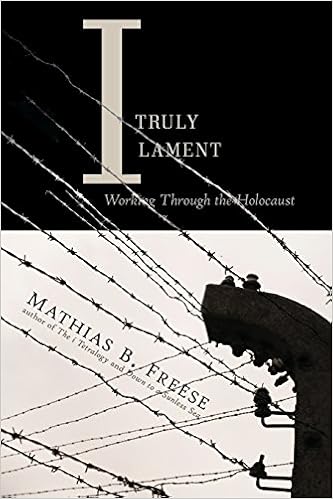
I Truly Lament

Mathias Freese shares a collection of stories in his book, I Truly Lament. The stories revolve around the Holocaust and share points of view with guards, golems, survivors, and victims. This collection is not for the faint of heart. The stories aren't all blunt, they aren't all gruesome. But then again, they are all blunt and gruesome; it was the Holocaust.

Twenty-seven stories make up this heart and mind wrenching collection. Though they each have their own critical factor and voice, Snow Globe I made my mouth drop open in disbelief and horror. A man dreams of his time in the concentration camps and it's snowing. To me, snow is a magical thing. It casts everything in beauty and innocence, giving it a chance to reappear as something better. Snow is used for making angels and ice cream, twirling about trying to catch a single flake on your tongue. But in this story, Freese uses snow as a torture device. As the man listens to the rules, snow accumulates around him and the other camp members. Soon he's drowning in it. Every reader will find a story that horrifies them, opens their eyes, or reminds them. This story was exactly that for me. Freese took something beautiful and turned it into a tortured nightmare. It was the Holocaust.

There was a bit of confusion in this collection for me. Since it is a fiction collection, I wasn't too sure on whether Max Weber was real or a stand-in for all people who think that the Holocaust was a hoax or exaggerated. With a bit of research, I believe I found the referenced man. Here's a little bit about his beliefs and work on Wikipedia.  Though, there is also Mark Weber, in which the name Max could have been substituted for the fictional representation. He's a leader of a Holocaust Denial Group as stated in this Wikipedia article. Either way, I'm sure survivors of the Holocaust who do know about these men are just as hurt as Freese makes them out to be.

Overall, the collection is nicely put together. I thought the order of each story made sense as a whole. It begins with a golem and the acceptance that help is far off. Each story adds to that belief with the struggle for food, for the will to live, and the loss of a loved one. Then the collection ends with a golem who struggles with his own existence and need. I've been to the Holocaust museum in St. Louis and I've studied it in school. But I've never gotten the chance to talk to anyone about it. And though, I still haven't, I Truly Lament has let me peek into the mind set of victims and survivors. A very worthy collection.

Rating: 3.5/5 Cups

Friday, March 28, 2014

The Mine

19353394In May 2000, Joel Smith is a cocky, adventurous young man who sees the world as his playground. But when the college senior, days from graduation, enters an abandoned Montana mine, he discovers the price of reckless curiosity. He emerges in May 1941 with a cell phone he can't use, money he can't spend, and little but his wits to guide his way. Stuck in the age of Whirlaway, swing dancing, and a peacetime draft, Joel begins a new life as the nation drifts toward war. With the help of his 21-year-old trailblazing grandmother and her friends, he finds his place in a world he knew only from movies and books. But when an opportunity comes to return to the present, Joel must decide whether to leave his new love in the past or choose a course that  will alter their lives forever. THE MINE follows a humbled man through a critical time in history as he adjusts to new surroundings and wrestles with the knowledge of things to come.

*May Contain Spoilers*

John Heldt takes readers back to a time in which World War II looms overhead with his time traveling novel, The Mine. Joel Smith never imagined that when the planets aligned it would create a path into the past, nor that he would be the one to stumble upon it. 

Joel Smith is the main character of this novel. A young man, about to graduate from college with a geology degree, who is over-the-top arrogant on the outside but has a hidden charm that readers will enjoy. His tongue is sharp with wit and he has a certain knack for causing trouble. Readers will connect with him based on the serious contemplations he keeps secret and love him for his live-for-the-moment attitude coupled with his need to keep others around him happy. 

The plot of The Mine focuses on Joel and how he discovers an abandoned mine the same day the planets are aligning, creating an escape to 1941. With war on the horizon, Joel becomes friends with a drafted man, his future grandmother, a Japanese-American, and a young college coed that steals his heart. He lives in the year of Pearl Harbor for six months wondering if he will ever return to his present or continue on in the past. The hardest question being whether he'll want to return or not.

Rating: 3/5 Cups

Wednesday, March 21, 2012

The Shroud of the Villa

Luigi Diamanti 
Hana, the nurse.
Caravaggio, the thief.
Kip, the bomb dis-abler.
The Unknown English Patient.

These four strangers, made strange by the war, come together in an Italian Villa at the end of WWII.

Hana hopes to cure the English Patient, whom she's fallen in love with. Caravaggio wishes to re-connect with Hana, after years of separation, and help her move on from the English Patient. Kip strives to disable all of the mines that were left behind, making the land safe once again but begins having trouble keeping Hana out of his thoughts.

And the English patient...
a burn victim with no name, only memories to cling to. A mysterious shroud hanging over the shoulders of the villa.
* *
The English Patient by Michael Ondaatje was a novel of poetic beauty. At the beginning I struggled to capture his thought and meaning because of the drastic shift of language between other novels I've read lately and The English Patient. 

Simon Howden
After twenty pages or so, the language morphed into such beautiful prose that I was voracious for more. 

The plot itself was based in memories. Memories of times before the war, comparable to times during and after. It was interesting to see the detailed changes in each character when the comparisons were made. 

With writing style, though beautiful, the stream of consciousness air the words had, made it a bit hard to follow at times. Breaks in the writing signified jumps in time, or a shift in who the story was focusing around. The lack, and sometimes unexpected appearance, of quotations made it difficult to understand when people were conversing or thinking. 

But, this gives the novel a kind of liquidity. It can move to fit the understanding of the reader instead of the reader bending to understand the novel. Each reader can take from the novel what they want, instead of it being forced upon them. 


     The English Patient
                             on Amazon
                
                          rating: 4/5 cups