Showing posts with label truth. Show all posts

Sunday, October 1, 2017

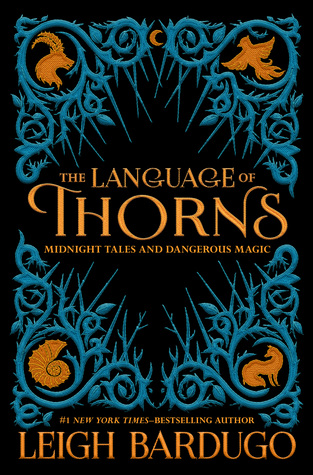
Short Story Sunday - The Language of Thorns #1


34076952

Ayama and the Thorn Wood


A monstrous son is born. A king builds a maze to keep him trapped. Yet, he escapes. 

The village people suffer and no one is able to stop the monster.

A family ashamed of one of their daughters sends her to be a messenger with the beast in hopes that they'll become rich and the monster will stop terrorizing the town, or at least be rid of their daughter.

Ayama is the main character of this opening short story of The Language of Thorns. She's a girl who wasn't born as beautiful as her sister and is therefore ostracized by her family. She is treated like a servant, forced to sleep in the kitchen, covered in ash and responsible for all of the chores. She's silenced by her family until she almost forgets how to speak. Yet, she's the only one in the village who will try to face the beast, speak to him, and try to save the town. It's when she reaches the monster that her voice is revealed, as well as her sharp tongue, quick wit, and honesty. The fact that these character traits are all revealed under duress show Ayama's bravery and courage. It also shows that these traits can be found in unexpected people. It reminds me of the old adage, don't judge a book by its cover. Because we can't judge a person based on their looks. It's their personality, their characteristics that matter. Just as Ayama proves in this short tale. 

When she arrives at the wood, the beast demands she tell him a story in exchange for her life. She adds truth to a fairy tale and he lets her leave unharmed, promising to leave the town's livestock alone. Her family is rewarded but Ayama is still treated like a servant. No one cares about her, only about their own freedom from the monster. Until it seems that he has returned to continue his terrorizing. So Ayama is once again sent to the woods.  

She once again must trade a story for her life. She again adds truth to a fairy tale and survives, saving the village yet again. A village that didn't care for her. A village that was too afraid to face the monster a young girl could face. But saving the village wasn't enough for the King. He sent her back to the monster with a specially crafted knife with orders to kill him. Ayama returns and tells him another story and she finds out the truth behind the King's accusations and the village's torment. 


In the end, truth prevails and the true monsters of the story are punished while those who look like monsters, but aren't, are rewarded. This opening tale of The Language of Thorns sets the tone for this collection of short stories as honest and representative of the cruelty sometimes found in leadership, the selfish nature of humanity, and that things aren't always as they appear. Though this story had a happy ending, we'll see if that continues over the next few weeks. The power of this opening story has me really excited to see what power the following stories have. 

My favorite part about this short story is that Ayama saves her own life by telling a story, a fairy tale, but with truth added to it. And by truth, I mean realistic outcomes. She removes (part of) the fantasy of the fairy tale and exchanges it for something she has learned from her own life. This adds a sadness to the story but also twists it to make it true for the monster. This act gives the story, and the art of storytelling, power. It demonstrates that sometimes storytelling, or sharing, can provide peace and save a life. 


Next Week: "The Too-Clever Fox" 

Thursday, March 31, 2016

The Sun That Shines & The Storm That Will Always Pass

28422060
This collection of poetry is about love, truth, life, and light. Four words everyone seems to live for. From the kings and queens of the world all the way down to the beggar on the street. All is a part of a living organism. It is of the wise soul who remembers his or her intrinsic personal philosophy while treading down the dark roads into the unknown.

**
 
Derek Warmington explores four main themes in his book of poetry, The Sun That Shines & The Storm That Will Always Pass. Those themes include love, truth, life, and light, outlined in the synopsis of the collection. Though how he illuminates these themes is the important aspect.
 
Warmington writes of love as something that can be chosen, as if it's sitting right in front of you. But also as something that happens, as if it's inspiration. The truth he writes of is a journey. He searches for the truth behind life, often including questions in his poems. The poems that focus on life hinge on the desire to live without fear and sometimes disagreeing with the search for meaning. He even toys with the idea that there is no meaning in life, it just simply is. And light, well, Warmington tackles the darkness of depression, exploring what exactly is meant by seeing a light at the end of the tunnel.
 
Warmington uses a few specific techniques in his poetry. The main one he uses is rhyme. Now, I'm not a big fan of rhyme because I think it can cause a line to be misinterpreted due to it's obvious emphasis on certain words. And I think that happens in some of the poetry in this collection. With Warmington's lack of punctuation to show where a thought begins and ends, the reader makes those choices subconsciously, which in turn can change the meaning of the poem. Warmington also uses alliteration and personification. In "Big World, Small Mind" he writes: "silent sidewalks sing their songs of sincere serenity," which exemplifies both techniques. Though these themes are universal, I think the focus on rhyme will hinder Warmington's connection with poetry readers.
 
Rating: 2.5/5 Cups


Sunday, August 12, 2012

Hemingway Point

When Jess spends the summer in her late grandmother's rambling Victorian summer cottage, she uncovers heart-rending mysteries and lost love. It has been seventeen years since Jess has last visited the elite lakefront summer club where she had spent the summers of her youth. 

Now, she returns with her photographer boyfriend who wants to write an article about the distinctive old house. Sifting through old letters and pictures she finds in a hidden trunk, Jess unravels long-hidden family secrets. Including, just maybe, the secret to her own heart.


*May Contain Spoilers*

Nora Carroll brings readers into the life of Jess Carpenter, a librarian who is called back to her summer vacation home after she inherits it from her grandmother, in her novel Hemingway Point. Though the story line is crafted to capture the love of readers, the novel itself falls short of expectations. 

Carroll intricately takes readers on a journey of discovering the truth about personal history. Jess believes she knows everything about her past, but while trying to sell her newly acquired property, she learns truths she would never imagine. I loved the plot of this novel. It has a great pace and more than enough enticement to grab the attention of any reader. 

Sadly, the editing of the novel takes away from the beautiful story. There were quite a few typos throughout the book that had me lost in confusion. At times, I had trouble concentrating on the story development because of the errors. 

I also felt I was creating half of the story in my head because of the dropped quotations in the dialogue. I had to mentally separate the dialogue that was actually being spoken and what was internal. It was a rather tough process and one that left me with a heavy sense of disappointment. I had to read the ending chapter twice just to have a faint idea of what happened with Jess and her first love. 

Another once-over would do this novel wonders, as the story is truly great. 

rating: 2/5 cups
Hemingway Point
on Amazon

Tuesday, October 18, 2011

Friend Instead of Character

Claire is getting closer to the truth about her mother's past and Michael is a little irked at the idea...

After finding a love letter written to her mother when she was only 17, Claire decided to search for the writer. Now she's in Capitola, California getting ready to move in to the house that the letter was sent from. The owner of the house, Michael, remembers her mother, Emily, but keeps his lips tight when questioned about the past.

Broke with worry nagging on Claire's very heartstrings, Michael decides that she would be the perfect person to live in the house and take care of his mother, Geraldine, for a small pay check and free room and board. But allowing Claire to be so close to his mother threatens to bring up the past, and Emily. He worries if his mother will be able to keep his secrets hidden from Claire while they live beneath the same roof.

Readers can relate to Claire's struggle and feel connected to her within the first few chapters. The basic needs of food and shelter, and how to pay for them, is something that everyone worries about. Readers will find themselves wishing they could be one of the characters helping Claire along her journey. In the novel Delivered with Love, Sherry Kyle writes Claire with faults and virtues, something many writers have trouble with, making Claire a friend to the reader, instead of just a character.