Showing posts with label memoir. Show all posts

Monday, November 26, 2018

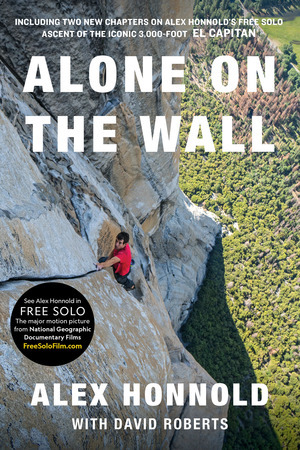
Alone on the Wall

36531127Something you all probably don't know about me from reading my book reviews (and why would you?) is that I love to rock climb. I'm a very outdoorsy person who enjoys hiking and climbing (not too tall) rock faces. That is why when I saw that Alex Honnold's book, which I hadn't read, was coming out in a new edition that featured three extra chapters on his free-solo of El Cap, I knew I had to get it! I ordered it quite some time ago but just finished it today during naptime. Here's the synopsis:

On June 3rd, 2017, Alex Honnold became the first person to free solo Yosemite's El Capitan—to scale the wall without rope, a partner, or any protective gear—completing what was described as "the greatest feat of pure rock climbing in the history of the sport" (National Geographic) and "one of the great athletic feats of any kind, ever" (New York Times). Already one of the most famous adventure athletes in the world, Honnold has now been hailed as "the greatest climber of all time" (Vertical magazine).

Alone on the Wall recounts the most astonishing achievements of Honnold’s extraordinary life and career, brimming with lessons on living fearlessly, taking risks, and maintaining focus even in the face of extreme danger. Now Honnold tells, for the first time and in his own words, the story of his 3 hours and 56 minutes on the sheer face of El Cap, which Outside called "the moon landing of free soloing…a generation-defining climb. Bad ass and beyond words…one of the pinnacle sporting moments of all time."

Review:
For those other lovers of rock climbing, this book is a must read! However, for readers who enjoy stories of adventure and uncertainty paired with detailed moments of heart-stopping fear, this book is also for you. Alone on the Wall shares detailed stories of many of Honnold's escapades with readers. He's climbed all over the world, literally. From Patagonia to Europe to Africa. The stories that accompany these climbs are intense and, as my husband says, make your palms sweat just reading it. Though I didn't feel any sweaty palms while reading, I definitely had to keep telling myself that Alex Honnold is still alive. Important information to know is that the type of climbing he does, free soloing, is climbing without ANY protective gear. That is NOT the type of climbing that I enjoy. I go for toprope and sport any day, but even thinking about free soloing something that means life or death with each movement is not for me. Reading about it though... now that's something I can get behind.

The book spans several years of Honnold's climbing adventures and even throws in a bit of a love story. One thing that bothered me a little bit was that, at some points, Honnold seems so arrogant it's nearly annoying. However, everyone that makes a quote in the book mentions that he's so down to earth. I can't really imagine that as I struggle with these two conflicting mental images. I'll have to take everyone's word for it as they know him and I, obviously, do not.

Regardless, this collection of adventures is definitely a book that rock climbers and non-climbers will enjoy. It's absolutely mind-blowing to imagine that someone has accomplished all of these fantastic feats. And the descriptions are so detailed that you can even picture yourself there, not that all readers would want to (too scary!). And, if you want to be able to actually see it (at least the climb of El Cap) --- you can! They made a movie during his climb, which is on my to-see list. Though, watch at your own risk, I've heard it's the most intense climbing movie so far.

Rating: 4/5 Cups 

Wednesday, February 7, 2018

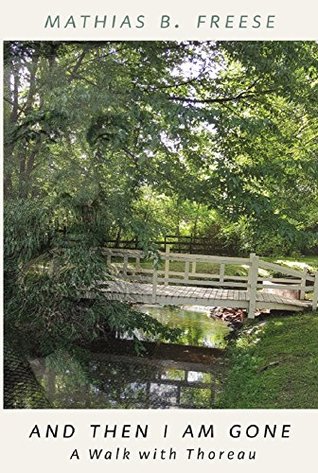
And Then I Am Gone - A Walk With Thoreau

36292321And Then I Am Gone: A Walk with Thoreau tells the story of a New York City man who becomes an Alabama man. Despite his radical migration to simpler living and a late-life marriage to a saint of sorts, his persistent pet anxieties and unanswerable questions follow him. Mathias Freese wants his retreat from the societal "it" to be a brave safari for the self rather than cowardly avoidance, so who better to guide him but Henry David Thoreau, the self-aware philosopher who retreated to Walden Pond "to live deliberately" and cease "the hurry and waste of life"? In this memoir, Freese wishes to share how and why he came to Harvest, Alabama (both literally and figuratively), to impart his existential impressions and concerns, and to leave his mark before he is gone.

**

The latest memoir from Mathias Freese shares a group of essays that work to examine, share, criticize, wonder, and, most of all, ask questions that don't necessarily have answers. At seventy-six years old, Freese is starting over with a house in the woods that cost a lot more than Thoreau's jealousy-inducing twenty-eight dollar shack of peace. However, the house itself represents the offering of a simpler life, even if it comes with a heavy restoration bill. 

The idea behind this memoir seems to be connecting with Thoreau but also connecting with the self. Freese writes about his health problems and the health problems of his wife. He shares words of wisdom as well as words of heavy criticism, including criticism of the political climate the U.S. is currently experiencing. However, the heaviest subject that Freese explores is that of his own impending death. Not that he's dying of a specific disease or cause, but he is slowly moving toward the end of the lifespan of a typical human being. With that added weight, Freese questions his self while examining his personal discoveries and sharing what brings him joy. 

My favorite parts of this memoir were when Freese focused on his own writing. His process and reason for writing were incredibly interesting to me and I found myself most absorbed in the essays that tackled this subject. Or included it. Maybe it's the writer in me or the student, but when Freese shared his experiences with bits of writer's block as well as his personal motives for writing, I felt engaged with the essay, not just connected to the writer. 

Though Freese only focuses directly on Thoreau in the opening and closing essays, Thoreau's influence runs throughout the entire collection. While I was reading, I found myself and my feelings coinciding with what Freese was examining. I laughed, I felt joy, I felt fear. Though I did expect a little bit of a hint toward or focus on feeling peace, that was not Freese's purpose for sharing these essays, at least not that I gathered. 

After reading this collection, I felt that Freese's purpose for writing these essays was to get to know himself as a man who is reaching the end of his life, as well as share what influenced him and question his own experience. However, I do wish I'd read more of Thoreau's Walden then just excerpts before reading this memoir. I felt like I could have better connected with Freese had I read the entire book. Regardless, it was an interesting memoir that doesn't seem to fit in the genre of journal or autobiography. And Then I Am Gone is really a subjective interpretation of what could be the final leg of Freese's journey, though it doesn't have as many answers or conclusions a reader might expect. It offers the questions so that the readers can decide the answers. I think readers who enjoy internal exploration and perhaps those who enjoy philosophical meanderings would like reading this memoir. 

Rating: 3.5/5 Cups

Thursday, May 12, 2016

Tesserae: A Memoir of Two Summers

28762709Mathias B. Freese shares his life with readers through Tesserae: A Memoir of Two Summers. Tessera is the smallest piece of tile used to create a mosaic and Freese uses this definition as an outline for his memories. As he travels back to his childhood and splashes through time much like a Vonnegut pond, Freese sets it all out to dry. He wades through his memories, vulnerable and open, showing readers how life can change with one moment, one person, or even two summers.

This memoir is both about Freese spending two summers in Woodstock and not about Freese spending two summers in Woodstock. It's more focused on how those two summers changed him and though the timeline is a jumble of water droplets, touching and coalescing, readers will be able to grasp the before and after.

Before Woodstock vs. After Woodstock.

Before Woodstock Freese was an emotionally stunted man and he attributes the finding of himself and semi-acceptance of himself to the openness that Woodstock created. Or rather, allowed. As a child, Freese was raised by a depressed mother and a father who never made contact. Freese was alone and therefore lonely. He felt unloved, though he didn't know what love was. This bold pronouncement will undoubtedly pull readers into a sense of emotionally charged empathy. Therefore, Freese the writer gains the vote of the reader. The sympathy associated (or demanded) from a child who admits that he never received love from his parents is given freely. Freese bares his soul in this and readers respond.

Though the two summers at Woodstock are never fully laid out for the reader, Freese does share that the creativity and music were the main attractions for him. Important to note, the drugs were not. Woodstock let Freese be open for the first time in his life. The town, the events, they let him get lost in the creative magic and melody of life and love. Readers take in the impact that Woodstock had on Freese and see how much it helped him. However, he still struggled with love, commitment, understanding, and acceptance.

Mathias Freese is an inspiring and inspired man, often quoting philosophers and other writers, even movies. And he has his scars much like anyone else. Freese, while sharing his change for the better, doesn't leave out the bad. He admits to being a shoddy father and an adulterer. He blames himself for many things, trying, yet failing, to hide from their repercussions. This doesn't allow readers to like him anymore as a narrator, but it does make him more trustworthy. Sharing the bad is much more difficult than sharing the good and Freese faces that head-on.

The memoir is written as a collection of essays jumping through the years in a non-linear way. It truly reminded me of Vonnegut's lake in Slaughterhouse Five. The memoir even includes therapy session scripts, which I assume are legitimate, and chapters written from the perspective of his children, which may just be creative nonfiction, though I'm not sure. They seemed of the same writing style of Freese and one was written in past tense (as if Freese had died) so I'm leaning more towards the fact that it could be a projection of sorts.

Tesserae: A Memoir of Two Summers is so much more than a memoir. It's a study of life and love and shattered pieces of the soul that somehow make up a person. It's a self-analysis with as much honesty as can be given, each tile laid out to create the whole.

Rating: 4.5/5 Cups


Friday, October 18, 2013

A House in the Sky: A Memoir

18039963As a child, Amanda Lindhout escaped a violent household by paging through issues of National Geographic and imagining herself in its exotic locales. At the age of nineteen, working as a cocktail waitress in Calgary, Alberta, she began saving her tips so she could travel the globe. Aspiring to understand the world and live a significant life, she backpacked through Latin America, Laos, Bangladesh, and India, and emboldened by each adventure, went on to Sudan, Syria, and Pakistan. In war-ridden Afghanistan and Iraq she carved out a fledgling career as a television reporter. And then, in August 2008, she traveled to Somalia—“the most dangerous place on earth.” On her fourth day, she was abducted by a group of masked men along a dusty road.
 
Held hostage for 460 days, Amanda converts to Islam as a survival tactic, receives “wife lessons” from one of her captors, and risks a daring escape. Moved between a series of abandoned houses in the desert, she survives on memory—every lush detail of the world she experienced in her life before captivity—and on strategy, fortitude, and hope. When she is most desperate, she visits a house in the sky, high above the woman kept in chains, in the dark, being tortured.

*May Contain Spoilers*

Prepare to be held hostage in a country waging a war still current enough to feel the aftershock with Amanda Lindhout in her memoir, A House in the Sky, written with Sara Corbett. The raw writing style and honesty with which Amanda tells her story is both haunting and beautiful. 

Amanda shares her story with readers from the beginning, when traveling the world was just a dream. She worked to save enough money to fund a trip abroad for several weeks. After the first stint, Amanda discovered her love of the world and her desire to see it all. To ensure she could keep traveling she began working as a photojournalist. Through the memoir, readers watch Amanda change from a free, loving, adventurous woman into a mistreated captive who retreats into her own mind to escape the torture she experiences. Readers will connect with her open spirit and endless curiosity in the beginning of the memoir so easily that after she is taken hostage by Somalian renegades, it's as if readers are trapped along with her. 

The story that Amanda tells will haunt readers. Everything that Amanda lived and survived through is absolutely amazing and horribly astounding. The strength she had when she was living in absolute darkness, the hope that bloomed when she and Nigel (her close friend who was kidnapped with her) discovered a way to escape, and the beautiful world she focused on to help her keep breathing is heartbreaking and hard to understand. A House in the Sky is a poignant and terrifying memoir of one woman's courage to survive. I think though it may not be accessible genre-wise to every reader, it's definitely a book worth reading, and experiencing. 

Rating: 5/5 Cups

Wednesday, October 16, 2013

WWW Wednesday (70)

To play along, just answer the following three (3) questions…

• What are you currently reading?

• What did you recently finish reading?

• What do you think you’ll read next?


A House in the Sky     One Big Beautiful Thing     17558175

01. Currently Reading:
A House in the Sky: A Memoir by Amanda Lindhout and Sara Corbett. This memoir focuses around Amanda's love for traveling and her kidnapping as a photojournalist.

02. Recently Finished:
One Big Beautiful Thing by Marie Flanigan. Wonderful novel about facing your future after life has ruined your past.

03. Reading Next:
Dark Chatter by Andrew Branch. Never reviewed a book like this one. A novel that follows a college graduate as he finds himself accidentally working in the porn industry. This could be hilarious, or this could be terrible. We shall see.

Tuesday, October 15, 2013

Teaser Tuesday (83)


Teaser Tuesdays is a weekly bookish meme, hosted by MizB of Should Be Reading. Anyone can play along! Just do the following:
• Grab your current read
• Open to a random page
• Share two (2) “teaser” sentences from somewhere on that page
• BE CAREFUL NOT TO INCLUDE SPOILERS! (make sure that what you share doesn’t give too much away! You don’t want to ruin the book for others!)
• Share the title & author, too, so that other TT participants can add the book to their TBR Lists if they like your teasers!

A House in the Sky


A House in the Sky: A Memoir
   - Amanda Lindhout and Sara Corbett

One of the best things you can believe about the world is that there is always, no matter what, someone worth longing for.

Tuesday, August 6, 2013

Teaser Tuesday (73)


Teaser Tuesdays is a weekly bookish meme, hosted by MizB of Should Be Reading. Anyone can play along! Just do the following:
• Grab your current read
• Open to a random page
• Share two (2) “teaser” sentences from somewhere on that page
• BE CAREFUL NOT TO INCLUDE SPOILERS! (make sure that what you share doesn’t give too much away! You don’t want to ruin the book for others!)
• Share the title & author, too, so that other TT participants can add the book to their TBR Lists if they like your teasers!

Product DetailsGet Me Out of Here: My Recovery from Borderline Personality Disorder (p.140)
   - Rachel Reiland


It's dangerous when the raw black-and-white emotions of a child are harbored in an adult's mind and body.

Friday, July 6, 2012

It Rains In February


On the 24th of February 2007 my husband, Stuart, drowned himself at sea, leaving me widowed with two young daughters aged six and four. I knew it wasn't an accident, even though the medics and police never suspected suicide. Stuart had been talking about ending his life for a year. His most recent suicide attempt had been only three weeks earlier. Afterwards, he explained that day as the most peaceful day of his life. Sitting next to the dam, he smoked his last cigarette. He drank a hundred sleeping pills and did a final check to make sure everything would look like an accident. The last thing he remembered was swimming out into the crystal clear water. He said that he was no longer scared of dying, that there was nothing scary about it. Living was the scary thing.

It Rains In February: A Wife's Memoir of Love and Loss is the true story of a husband's depression and obsession, not only with another woman, but also with ending his life. In this honest and heartfelt narrative, Leila Summers weaves a compelling tale of the year that led up to Stuart's suicide and the grief, profound loss and self discovery that followed. Although each suicide is unique, this book gives the reader an insider's view from one perspective by way letters and e-mail messages. - Goodreads Blurb

**
It Rains In February is the first memoir that I've ever reviewed and Leila Summers made it too easy to love this book. Or maybe that just makes reviewing it harder. 

As Leila retells her tale of sadness and fighting her husband's depression, readers will find themselves slipping into her shoes and walking through her journey. This memoir covers the year that Robyn's (Robyn is the name Leila Summers used for herself in the book) life fell apart, piece by piece. It begins with Robyn's husband, Stuart, being in love with another woman, who loves him back in words but not in actions. When Stuart's love is unrequited, his life becomes a hell in which the love he has for himself drains to non-existence. 

Throughout the entire book, Robyn fights to give Stuart something to live for, though he already feels his life has been lived and he's ready to die. There were many points throughout the memoir that I felt like I needed a good cry as I read about Robyn sitting on her veranda, smoking cigarettes and drinking a glass of wine, wondering how she was going to save Stuart. There were other times when I wanted to reach through the screen of my Kindle and slap Stuart across the face and ask him, in a tone louder than normal, "What the hell are you doing?!"

It Rains In February brings out so much emotion from the readers because Robyn is so open, raw, and honest with what happened. And she definitely doesn't go easy on herself. Readers will be able to see how much she tried to save her husband and how that negatively effected her. 

There were a couple times throughout the novel that seemed to have a timeline problem. Robyn would be discussing one event that would remind her of another. Then she would bounce between the two, describing them both. Though this helped the book read as a stream of conscious novel, it also created small bits of chaos where I would have to stop and re-piece the scene together in my mind. 

Upon finishing this book, I was filled with a sense of sadness melded with peace. The entire novel is a first hand account of what the-person-left-behind struggled through and dealt with when someone near them was suicidal. 

It's amazing that anyone could write a book such as this with as much love, hope, faith, and belief as Leila Summers did. A novel worthy of unrelenting commendation. 

on Amazon
rating: 4/5 cups