Showing posts with label mental illness. Show all posts

Friday, May 11, 2018

Fallout Girl (Hollywood Lights #5)

38205327The day she buries her mother, Miranda George jumps on a plane from North Carolina, telling no one where she’s heading. She wants to disappear and start over. She arrives on the Los Angeles doorstep of college friend Daphne Saito, and even though Miranda hasn’t seen Daphne in years, Daphne welcomes Miranda into her home and her makeshift L.A. family.

The problem is, Miranda is on the run from family. All family. Family, in Miranda’s experience, can get you killed.

Miranda takes off again, but this time her plan is much more sinister. She certainly doesn’t expect her friends to track her down. When they bring her back from the edge, the question remains: will Miranda be able to save herself and her newfound friendships? Or will she remain strangled by the past?

*May Contain Spoilers*

Fallout Girl, by Katie Rose Guest Pryal, introduces a strong female lead who suffers from a mental illness to the series and to the group of Hollywood friends. Miranda George was raised by a mother suffering from bipolar disorder and is now aware that she, too, has the mental illness. With firsthand experience from trying to care for her mother, Miranda is determined to stop her illness from hurting anyone she cares about, but that doesn't include herself. 

Miranda is portrayed as a blunt, brutally honest, and incredibly intelligent young woman. However, her bipolar disorder also makes her reckless, overly adventurous, and prone to push people away. When she arrived in L.A., Miranda thought she was escaping to an old college acquaintance who wouldn't care enough to try to save her. Luckily, she was way off base. Miranda, instead, finds a group of people who are caring, loyal, and willing to accept her as a friend. Through these personality traits and the events of the book, readers will, without a doubt, connect with Miranda. Though her mental illness isn't discussed at length, the author demonstrates the symptoms through Miranda's actions. This gives readers an in-depth, realistic look at bipolar disorder and how it can affect those who have it. Readers will not only understand why Miranda is acting the way she is, they'll witness moments when her mental illness takes over. With that kind of openness, readers will form a strong bond with Miranda and want her to heal as the book continues. 

The plot of the novel begins after Miranda has already arrived in L.A., where the series takes place. Miranda is determined to escape her mental illness using drugs, danger, and sex while she forms a plan to take her own life. Yet, the people she meets while crashing at Daphne's apartment (an old acquaintance from college) begin to care about Miranda and notice that something is happening to her. With good intentions and help from Miranda's brother, the group tries to help Miranda accept her mental illness and move toward a life that allows her to control it. 

Though Fallout Girl has a very serious storyline, it is an incredibly entertaining and interesting book. The mental illness aspect is represented as realistically as it can be while still allowing the book to have an enjoyable air. There is a romantic aspect of the book that will also have readers cheering for Miranda, even though her destructive nature threatens her chance at a relationship multiple times. With various layers of interaction, shifting point of views, and serious undertones, Fallout Girl is a book that seriously represents living with bipolar disorder and presenting friendships that grow and evolve with the people who are a part of them. 

Rating: 4/5 Cups

Sunday, April 15, 2018

Norwegian Wood

11297Toru, a quiet and preternaturally serious young college student in Tokyo, is devoted to Naoko, a beautiful and introspective young woman, but their mutual passion is marked by the tragic death of their best friend years before. Toru begins to adapt to campus life and the loneliness and isolation he faces there, but Naoko finds the pressures and responsibilities of life unbearable. As she retreats further into her own world, Toru finds himself reaching out to others and drawn to a fiercely independent and sexually liberated young woman.

*May Contain Spoilers*

Norwegian Wood by Haruki Murakami is probably one of the strangest yet intriguing books I have ever read. Murakami utilizes a variety of themes to explore the love life and coming of age story of Toru. However, most of these themes are weighed down with the theme of death. As several characters in the novel commit suicide, I think Murakami uses the looming nature of death to highlight the difficulties of life. 

Toru is the main character and the narrator of the novel. He's a young college student who is learning to navigate the world of love, sex, and being an adult. His young adulthood has been heavily influenced by the suicide of his best friend that occurred a few years earlier. When he reconnects with his deceased best friend's former girlfriend, Naoko, Toru falls in love with her but must help her and recognize that she struggles with depression and (perhaps) other mental illness. 

Toru is a semi-likeable character as he's intelligent, morally guided overall, and mostly supportive of the few friends he has. I say 'mostly' because he does poke fun at his roommate and remains friends with a playboy, even participating in some one-night stands of his own. The main thing about Toru is that he is flawed so that makes him both relatable and influenced by the story's action. However, in that flawed nature, he isn't a very reliable narrator. He constantly doubts his memory which then transfers doubt to the reader. Within that doubt, readers still feel connected to Toru based on both his experiences and the emotions he evokes. Toru is a hopeful young man who is caught between a love of the past and a chance for love in the future. 

The entire story is a told as a flashback, as Toru relives the days of knowing Naoko because he hears a cover of The Beatles' "Norwegian Wood." While Toru tells the story, he seems to get lost and the present becomes the memory while the past fully takes over. Though this book is interesting and pulls the reader in from the beginning, it is incredibly sad with no real conclusion. For as much emotional investment the book requires, it seems that the payoff would be bigger. Or at least, the conclusion more clear. Overall, I was dedicated to this book and kind of disappointed with how it ended. I almost felt like I was being punished for making it to the end. I wouldn't recommend this book to everyone and definitely not just anyone. In terms of literature, this book is interesting in the way it presents Westernization and cultural influences. However, I don't think everyone would be a fan. It's a book that requires contemplation and analysis to even begin to unpack everything that Murakami tackles. 

Rating: 3/5 Cups
 

Monday, July 11, 2016

The A to Z of Normal

26028328Clare Thorpe’s need for order and symmetry governs everything she owns – from tins and toiletries, to cushions and clothes.
Yet she has always managed to hide the compulsions dominating her world. Until now.
When long-distance boyfriend Tom proposes, her secret life begins to unravel. How can she share a future with the man she loves, if she can’t even share her space?
And when the only way forward brings a threat greater than any compulsive behaviour, do they have a future together at all?
A poignant and humorous story of love, family, secrets…and military precision.

*May Contain Spoilers*

Helen Barbour takes readers inside the life of a woman plagued with Obsessive-Compulsive Disorder who desperately wants to find peace in her novel, The A to Z of Normal. It takes Clare hours to perfect her home and now that she's engaged, she doesn't want problems popping up in her relationship. So Clare decides to take control of her controlling OCD and try to muss it up a bit. 

Clare is a really nice, likeable character. The story focuses solely on her so readers get the in-depth look into her world with OCD. It's easy to see that living with this disorder is an everyday struggle. Readers will connect with Clare empathetically as well as sympathetically, but there's also her personality outside of the controlled realm that readers will see and like. She worries about her father, her sister, her niece and nephew. Clare's a fantastic Auntie who spends real, quality time with her niece and nephew. Clare is also loving, friendly, and a bit naive. The OCD doesn't define her and Clare learns that when she tries to overcome it. The only thing I didn't like about Clare was the cheating incident ... and then the lying incident. I don't think it's right that she failed to tell Tom about it, but I also don't think it's right that another character basically tricked Clare into thinking her relationship with Tom was over. It's a catch-22 situation, but I think Clare should have come clean. 

The A to Z of Normal is a well written novel with humor, love, acceptance, and strength. I really enjoyed the dialect that Barbour used for this novel. It was fun to read the British-English terms in the dialogue and the narrative. The plot was pretty well laid out, Clare and Tom get engaged at the beginning causing Clare to realize that she has to work on her OCD if they're ever going to live together happily ever after. Throw a couple of wrenches into that simple plan and readers will enjoy the bumpy ride. I'm sure this novel could help those living with OCD to know they aren't alone, but it's also a book for people who are interested in understanding OCD a bit better while being entertained with a love story. 

Rating: 4/5 Cups

Tuesday, July 5, 2016

Killer Potential

30315415Seventeen-year-old Yvette doesn’t know what’s worse: being locked up on a high security psych ward for a crime she’s not sure she committed, or having to see the vacant eyes of her fellow patients.

All she wants is her sister back, her parents to get a clue, her brother to quit dealing drugs, the murder trial to be over, and most of all, to be reunited with the pretty little pills that change the gory red on her hands to a much more pleasant hazy blue.

Well that and serious, hard-core, merciless revenge.

*May Contain Spoilers*

Aften Brook Szymanski surprises readers with possibilities in her novel, Killer Potential. Yvette has had an undoubtedly hard time growing up. Her father is always busy, her mother doesn't seem to care, and she has trouble getting along with her foster siblings. Meanwhile her older sister is too absorbed with skipping class and her little brother... that blood isn't thicker than anything. 

But is that the background of a killer? A seventeen year old murderer? Potentially. 

Yvette is depicted in two time frames within this novel: the past and the present. The past tells the story of moving around a lot, her dad trying to keep a paying job. Yvette's mother is depressed, struggling to raise her three children and make money by taking care of foster children. Throughout this, Yvette didn't get a lot of attention. She was the tattle tale, trying to keep everything in order. She didn't like to get in trouble or step out of line. That didn't make her foster siblings too keen to be nice to her. 

With the past, readers see how lonely Yvette was as a little girl, and how much she wanted to be close with her older sister. The past moves quicker than the present and soon Yvette is teen. She's experienced fear, loss, and confusion. Her mother is too interested in taking medicine to make the pain go away than getting out of bed, while her dad is still constantly gone. But as the past draws closer and closer to the present, the closer the truth is to coming out. The truth behind Yvette's current living situation in a maximum security psych ward. 

In the present, Yvette is suffering. She's in a psych ward for a murder she may or may not have committed. She's completely dependent on pills because they help her escape what happened for a little while. What's interesting is that it seems every time Yvette takes a pill, that's when the past comes back and reveals a little more about what's going on to the reader. Yvette is a terrifying girl in the present. She's manipulative, depressed, and rude. 

The contrast between the past and present is intriguing because the reader has to figure out how Yvette got to this point and Yvette isn't a very reliable narrator. That unreliability causes readers to second guess what they're being told and shown. But that's also what makes this novel so entertaining to read, the reader gets to make assumptions and guesses that may or may not be true by the end of the novel. And readers have no idea what exactly happened until the final few chapters. Also, as a  young adult novel, it traverses dangerous territory. It talks about self-harm, drug use, drug overdose, drug dealing, and rape, among other things. Killer Potential isn't for everyone, but it is an entertaining novel with mystery, intrigue, and a character with the potential to be a killer.

Rating: 3.5/5 Cups

Thursday, March 26, 2015

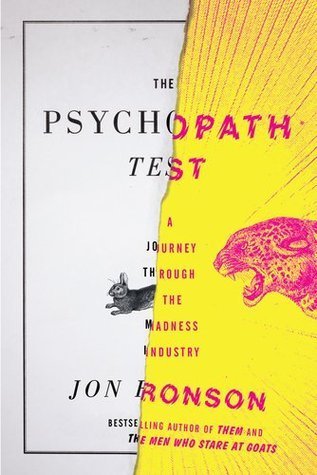
The Psychopath Test

12391521They say one out of every hundred people is a psychopath. You probably passed one on the street today. These are people who have no empathy, who are manipulative, deceitful, charming, seductive, and delusional. The Psychopath Test is the New York Times bestselling exploration of their world and the madness industry.

When Jon Ronson is drawn into an elaborate hoax played on some of the world’s top scientists, his investigation leads him, unexpectedly, to psychopaths. He meets an influential psychologist who is convinced that many important business leaders and politicians are in fact high-flying, high-functioning psychopaths, and teaches Ronson how to spot them. Armed with these new abilities, Ronson meets a patient inside an asylum for the criminally insane who insists that he’s sane, a mere run-of-the-mill troubled youth, not a psychopath—a claim that might be only manipulation, and a sign of his psychopathy. He spends time with a death-squad leader institutionalized for mortgage fraud, and with a legendary CEO who took joy in shutting down factories and firing people. He delves into the fascinating history of psychopathy diagnosis and treatments, from LSD-fueled days-long naked therapy sessions in prisons to attempts to understand serial killers.

Along the way, Ronson discovers that relatively ordinary people are, more and more, defined by their most insane edges. The Psychopath Test is a fascinating adventure through the minds of madness.

**

When I first added this book to my reading list, I thought it was fictional. I know, I know. Silly me. Upon finding it at the library last week, I immediately checked it out and dove right in. And then I realized it was non-fiction and I wasn't reading a mystery novel but a collection of interviews, news clippings, and first hand experience with psychopaths, which sounds more like a slur the more I hear it.

Jon Ronson begins with Being Or Nothingness, a mysteriously packaged book delivered to top scientists/thinkers around the world. And apparently, you can now purchase the book that started it all on Amazon for a steep forty dollars. After being hired to find the author and why it was sent to who it was sent to, Jon finds himself on the cusp of psychopath studies. Being a journalist, he obviously doesn't even think twice about stepping into this new and strange world. The journey he then goes on is an incredibly interesting tale of misuse of mental illness diagnosis, fear, and how the industry determines psychopathy. Though there are no main characters to connect to, readers will have a simple connection with Ronson, who shares his own anxieties and worries as the investigation continues. 

Though the book does have a linear fashion, that doesn't stop it from being confusing at times. As a reader that has no prior in-depth study of psychology, just your basic 101 college course, it was sometimes hard to understand what the interviewees were actually saying. Also, it was a bit difficult to know where Ronson was headed overall. What was his actual goal in doing this? At the beginning I thought he was going to compare psychopathic characteristics to the personalities of company bigwigs and politicians to find out if psychopaths have a greater tendency to gain leadership positions. Then I thought Ronson would just focus on Tony and others who he met while on this journey. But neither was fully the focus, both were the semi-focus with the end being more of an actual conclusion based on evidence presented: the madness industry defines psychopathy by the psychopathic events. Mental insanity is defined by the insane moments. Instead of seeing the blurs, the crossed lines, and the overall picture -- the focus is on the bits and pieces, not the whole picture. The Psychopath Test is an interesting exploration of the psychology world that isn't afraid to peek inside a maximum security asylum to cover all avenues. 

Rating: 2.5/5 Cups

Monday, February 23, 2015

Polarity in Motion: Blog Tour

23120782
Fifteen-year-old Polarity Weeks just wants to live a normal life, but with a mother diagnosed with borderline personality disorder, that’s rarely easy. Her life gets exponentially more disastrous when her sixth-period history classmates start ogling a nude picture of her on the Internet. Polarity would never have struck such a shameless pose, but the photo is definitely of her, and she’s at a complete loss to explain its existence.


Child Protective Services yanks her from her home, suspecting her parents. The kids at school mock her, assuming she took it herself. And Ethan, the boy she was really starting to like, backpedals and joins the taunting chorus. Surrounded by disbelief and derision on all sides, Polarity desperately seeks the truth among her friends. Only then does she learn that everyone has dark secrets, and no one’s life is anywhere near normal.

Review:
Brenda Vicars explores the hardships of mental illness, adolescence, and bullying in her novel, Polarity in Motion. Covering an array of genres, this book will reach out to multiple audiences. Coupled with the mysterious nature of the plot, the relationships between characters are intriguing and unsteady which add to the believable and realistic narrative.

Polarity Weeks is a girl on the cusp of adolescence as a ninth-grade student, but she's aged with experience. Her mother has been diagnosed with Borderline Personality Disorder and is subject to jarring mood swings. Though Polarity understands her mother's condition to the best of her ability, her interactions with her mother often resemble strolling through a mine field. The understanding nature of readers will allow them to immediately connect with Polarity, especially if they have a similar experience with mental illness.

Polarity, though young, is a brave and trustworthy soul. When the nude photograph is displayed in a computer class, readers will have various reactions. My first thought was that Polarity had some sort of mental illness of her own that had yet to be discovered. Other readers may believe that it was a production of Photoshop. Regardless, the openness and goodhearted nature of Polarity will at least have readers leaning toward an innocent ruling. As the book continues, readers will want the mystery solved almost as much as Polarity does herself.

Vicars portrays bullying in an accurate fashion and readers will side with Polarity upon witnessing the mean and hurtful actions that her peers commit. This only strengthens the connection between Polarity and the readers, whether they have been in a similar situation or not. The supporting characters in the novel are divided between those who support Polarity and those who do not, with her mother straddling the fence. The only way to further connect with Polarity would have been for readers to witness the photograph being taken without having knowledge of the fact. Knowing at the beginning that her innocence was not in question could have allowed me to connect with Polarity on a deeper level. I would have felt like fighting with her against the onslaught of disbelief instead of holding back and internally questioning whether I truly thought she was guilty or innocent.

Polarity in Motion begins with the mass sharing of the nude photo of Polarity and follows the investigation of her parents, classmates, and friends. At times the plot moves slowly, as does the investigation to find out the truth. Through the whole ordeal, readers come to know Polarity, her future goals, her family, and her feelings. They also witness her grow from a young girl to a young woman who has strength and confidence in herself and her abilities. Stemming from a negative situation is a real coming of age story that many readers will relate to and learn from. Polarity in Motion tackles some big issues and Vicars takes a chance with the plot's controversial situations, but a story like this can open eyes.

Rating: 4/5 Cups


http://i1.wp.com/redadeptpublishing.com/wp-content/uploads/Authors/Brenda-Vicars.jpgMeet the Author:
Brenda Vicars has worked in Texas public education for many years. Her jobs have included teaching, serving as a principal, and directing student support programs. For three years, she also taught college English to prison inmates, and outside of her job, she mentors children of incarcerated parents.

She entered education because she felt called to teach, but her students taught her the biggest lesson: the playing field is not even for all kids. Through her work, she became increasingly compelled to bring their unheard voices to the page. The heartbeat of her fiction emanates from the courage and resiliency of her students.

Brenda’s hobbies include reading, woodworking, gardening, and Zumba.

Giveaway

Monday, May 12, 2014

Taking Stock & Giveaway

18585947Just as Sheldon Mason is about to end it all, he meets his upstairs neighbour, a drug dealer named Sam. Sam gets him professional help, as well as a job at a local grocery store.

As he struggles to make sense of his life, Sheldon starts to notice something odd about one of his new co-workers, Gilbert Ryan. Gilbert seems to know about Sheldon's mental health issues - in fact, he seems to know secrets about everyone.

And Gilbert sees value in Sheldon...


*May Contain Spoilers*

 Scott Bartlett explores mental illness in his novel, Taking Stock. The main character is a young man who is dealing with the aftermath of his mother's death. Killed by a drunk driver, Sheldon's mother leaves him all alone in world full of secrets, guilt, and blackmailing.  

Sheldon struggles with suicidal thoughts and is attempting to take his own life when he's found by his neighbor. This neighbor steps in and tries to help Sheldon by taking him to the hospital so that Sheldon can deal with his depression and suicidal thoughts. Sheldon is filled with doubt, guilt, fear, and feelings of worthlessness. When his neighbor helps him land a job at a grocery store, things begin looking up. However, everything quickly takes a turn for the worse when Sheldon is confronted with drugs, pretense, liars, and the reality of human nature. Readers will connect with Sheldon while he is at his lowest, immediately hoping that he can turn his life around and mentally heal. This relationship will grow as he searches for a reason to want to live. 

The story line follows Sheldon's stay at a psychiatric ward and his life after, often switching back and forth between them. The time line weaves between the two events, combining them and separating them equally. Sheldon becomes privy to the grocery store secrets which comes to threaten his path to mental health. Taking Stock is an exploration of mental illness and how hard life can be to live. Though the situations that Sheldon finds himself in are not relatable to every reader, the struggle is the real focus and readers will empathize with Sheldon's journey through life with his illness. 

Rating: 3/5 Cups

Saturday, August 17, 2013

Get Me Out of Here

421518Borderline Personality Disorder. "What the hell was that?" raged Rachel Reiland when she read the diagnosis written in her medical chart. As the 29-year old accountant, wife, and mother of young children would soon discover, it was the diagnosis that finally explained her explosive anger, manipulative behaviors, and self-destructive episodes- including bouts of anorexia, substance abuse, and sexual promiscuity. With astonishing honesty, Reiland's memoir reveals what mental illness feels like and looks like from the inside, and how healing from such a devastating disease is possible through intensive therapy and the support of loved ones.


*May Contain Spoilers*

Get Me Out of Here by Rachel Reiland is a mental illness memoir that shakes the core of it's readers. As Rachel realizes that she's about to hit rock bottom, she takes a chance on therapy as a last effort to save herself. 

As Rachel suffers from Borderline Personality Disorder, it's hard to connect with certain personality traits because they are from her illness. She's moody, angry, aggressive, and spiteful. But simultaneously, she is a loving mother, gratuitous, giving, and brave. Through the ups and downs of her disease, the four years that are roughly documented in this memoir bring readers in and let them experience not only what Borderline Personality Disorder is, but also what it's like from the outside. The explosions she has, the moments when she can't control herself, and the discussion that stems from them is eye-opening. Some readers will have a hard time relating to Rachel, but I think the number of those that do will be surprising. 

This memoir documents Rachel's journey from the depths of her illness, through therapy, to the life she's never imagined. Though the memoir does jump around a few times, the plot moves in a linear direction, making it easy to keep up with where Rachel is in her journey. I think this novel will touch readers and help them to understand what it's like to live with an illness. Definitely helpful for those who are living with, or know, someone with a mental illness. 

Rating: 3.5/5 Cups

Non Fiction Genre in The Genre Variety Challenge

Thursday, April 4, 2013

Branded (Fall of Angels #1)

Jessica had the nightmares for as long as she can remember. Nightmares of being judged by people who have died, of being branded by the angels. Her friends and family think she's crazy because of it all. Yet she carries the mark of the condemned, seared into the back of her neck, and hides it and herself away from the world.

But when two men she can't ignore enter her life everything changes, including the nightmares. The two of them couldn't be more different. She will do anything to be with one of them. Even tell him the truth about angels, why she never sleeps, and the scar on the back of her neck. But one of the two has set events into motion that will pull her toward her own judgment and turn her into the object of her greatest fear.

*May Contain Spoilers*

Keary Taylor delivers a heart-wrenching tale in which the main character stands trial for those who die, either being exalted or condemned. And oh-my-wow, what a tale it is. The storyline had me hooked from page one. I've been voraciously reading for the past two days and it was definitely worth it. 

Jessica Bailey is the main character. A twenty-year-old girl who ran away from home before her mother could institutionalize her because of her nightmares. The nightmares where she is judged for acts she never committed. She finds herself in Washington state acting as caretaker for a lake house, where no one can hear her screams as she fights off sleep and the trials. Jessica is an innocent character, very down to earth (surprisingly), and has all of the characteristics of the average young woman. She prays that the trials will stop and she'll be able to lead a normal life. Readers will connect with Jessica based on her personality and the empathy she evokes. As she attempts to make new friends, become socially active, takes care of her mentally troubled neighbor, and falls in love, readers will come to see Jessica as a close friend. 

The plot line follows Jessica's nightmares, which have always been consistent, until now. The dreams are starting to change as well as the angels within them. As the dreams change, so does her everyday world. Certain things become more intense and Jessica starts wondering if the angels could follow her into reality. Taylor does a wonderful job crafting a supernatural story that convinces the reader that it could be real. There were a few parts where a clue to the plot repeated itself and the end was a little less extreme as it promised. But that won't stop me from reading the rest of the series. Definitely going on the TBR. 

Rating: 4/5 Cups

Sunday, February 17, 2013

Sharp Objects

WICKED above her hipbone, GIRL across her heart
Words are like a road map to reporter Camille Preaker’s troubled past. Fresh from a brief stay at a psych hospital, Camille’s first assignment from the second-rate daily paper where she works brings her reluctantly back to her hometown to cover the murders of two preteen girls.

NASTY on her kneecap, BABYDOLL on her leg
Since she left town eight years ago, Camille has hardly spoken to her neurotic, hypochondriac mother or to the half-sister she barely knows: a beautiful thirteen-year-old with an eerie grip on the town. Now, installed again in her family’s Victorian mansion, Camille is haunted by the childhood tragedy she has spent her whole life trying to cut from her memory.

HARMFUL on her wrist, WHORE on her ankle
As Camille works to uncover the truth about these violent crimes, she finds herself identifying with the young victims—a bit too strongly. Clues keep leading to dead ends, forcing Camille to unravel the psychological puzzle of her own past to get at the story. Dogged by her own demons, Camille will have to confront what happened to her years before if she wants to survive this homecoming.

*May Contain Spoilers*

Gillian Flynn disturbs readers with her addictive novel, Sharp Objects. The story line, the writing style, the characters, all combine to horrify the audience to the point where they don't want to keep reading, but they don't have a choice. Flynn's creative tying of the reader to the main character, Camille. 

Camille is a young woman who suffers with mental instability. Her body burns and tingles, begging to be cut into. Begging to be covered with words. Words that describe her life, her dreams, her fears. Camille's main desire is to be loved by her family, but her mother is incapable. Readers will connect with her through her emotions, whether evoking empathy or sympathy, disgust or understanding. 

The experiences that Camille lives through are heart-wrenching and sad. An eruption of chaos that can't be avoided. The bond between Camille and readers will be thoroughly strained before the last page, but I firmly believe everyone who starts this book will feel the need to finish it, regardless of the frightening display of human nature. Camille wants to be loved, and readers will offer it freely.

The plot focuses on two murders in her home town of Wind Gap, Missouri. As a reporter based in Chicago, Camille is sent back to get the scoop. Readers discover that she's in the middle of the chaos before Camille does and are immediately frightened for her well-being. But Camille has been sacrificing herself her entire life. Sacrificing her identity, her aspirations, anything and everything for one single act of love. 

The story line is a horrifying experience that readers won't be able to turn away from. It's gripping while disturbing like the cutting addiction Camille suffers from. I wouldn't recommend it for everyone as the novel is blunt, the descriptions are haunting, and the ending is worse than most could imagine. Never-the-less, outstanding piece of fiction. 

Rating: 4.5/5

Wednesday, December 7, 2011

Facing the Nightmares

How do you unravel a secret when the key is your memory?

Barbara Ellen Brink sets up the mystery of Fredrickson Winery, in her novel Entangled, with Billie inheriting the California winery from an Uncle she barely remembers meeting.

When keys and unwritten letters show up to drag her into the mystery that covers the winery, Billie is forced to face her past and determine why it was she who inherited the winery and if she should stay to run it.

Except, more is on the line that it first appears. The nightmares are back. And Billie is determined to face them.

No matter what.

Entangled is glowing twisted metal. A weapon that the reader doesn't know how to handle. The connection the reader forms with Billie will be different for everyone. The novel taps into mental illness, child abuse, domestic abuse, and night terrors, among other things. It's definitely an entanglement of emotions.  The multi-leveled novel is one that will keep the reader engaged and begging that no more secrets are hiding in the cellar by the last page.
Entangled on Amazon
rating: 4/5 cups